As an Amazon Associate this site earns from qualifying purchases.
Quick Picks
| Cooktop | Published power range | Noise-relevant published features | Link |
|---|---|---|---|
| Empava Electric Stove Induction Cooktop Vertical with 2 Burners Vitro Ceramic Smooth Surface Glass in Black 120V | 9 settings, 100W to a total of 1800W power sharing | Pan size sensor turns off when no pan is present; 1-99 minute timer | Check Price on Amazon |
| Empava Electric Stove Induction Cooktop Vertical with Dual Burners Vitro Smooth Surface 120V, 12 Inch, Black Ceramic Glass | 9 settings, 100W up to a total of 1800W power sharing | Pan size sensor heats the element to the size of your cookware; child control lock | Check Price on Amazon |
Disclosure: We earn a small commission from qualifying Amazon purchases at no extra cost to you.
Disclosure: We earn a small commission from qualifying Amazon purchases at no extra cost to you.
As an Amazon Associate we earn from qualifying purchases. This page contains affiliate links, and we may receive a commission if you buy through them — at no extra cost to you.
As an Amazon Associate, we earn from qualifying purchases.
Last Updated: September 2026
Here's the short answer: most induction buzzing, clicking and on-off cycling is normal physics, not a broken appliance. Buzzing usually comes from the pan — a multi-ply or loosely-riveted base vibrating in a rapidly switching magnetic field. Clicking is typically the cooktop's power electronics or a relay changing state. Cycling on and off at low or shared power settings is how many induction units deliver a fraction of full output. A genuine fault sounds different: it's a change from what your cooktop has always done, or it comes with an error code, a shutdown, or a smell.
This guide walks through each noise, tells you how to isolate it in a few minutes, and points out where the design of the cooktop itself is the variable — with three current induction units whose published specifications actually speak to these behaviors.
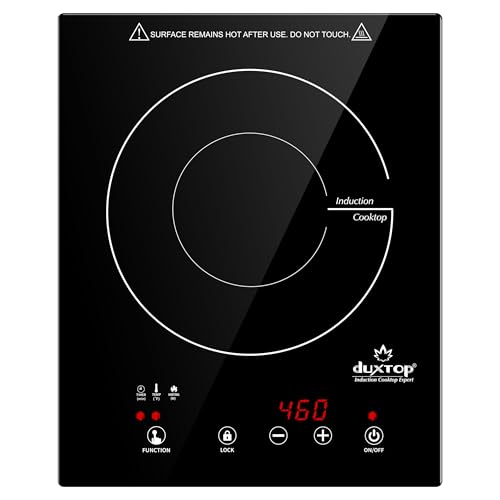
- CONVENIENT & PORTABLE INDUCTION BURNER: Duxtop induction cooktop offers both temperature and power modes for convenient and efficient cooking. Lightweight, portable induction
- BUILT-IN & PORTABLE USE: This induction cooktop can be built-in or countertop, with an elegant design that’s the perfect size for your kitchen. Sleek sensor panel with a built-in
The Problem: Four Different Noises, Four Different Causes
People lump every induction sound into "buzzing," and that's why the fixes fail. Separate them first.
Buzzing or humming. Loudest at high power, quieter as you turn it down, and it changes when you swap pans. That points at the cookware, not the cooktop.
Clicking or ticking. Often rhythmic, often at low settings, sometimes at the moment you change power level. Electronics changing state.
Whirring that continues after cooking. That's a cooling fan. Induction electronics sit under the glass and shed heat after a hot session.
The element cycling audibly on and off. Heat pulses, the pan noise rises and falls in a repeating pattern. This is normal low-power modulation on many units, and it is also what power sharing sounds like when two zones draw from one budget.
Step-by-Step: Isolate the Noise in Five Minutes
- Swap the pan. Put a different magnetic pan on the same zone at the same setting. If the sound changes or disappears, the pan was the source. Empava's listing states plainly that only cookware with a magnetic bottom will work properly, and suggests judging compatibility by whether a magnet sticks to the base ([S3]).
- Check the pan's size and flatness. Duxtop's listing specifies magnetic cookware with a diameter of at least 5 inches ([S5]). An undersized or warped base sits unevenly over the coil, and a base that isn't in solid contact has more freedom to vibrate.
- Change the power level and listen. If buzzing scales with power, that's a vibration story. If clicking appears only at low settings, that's the unit modulating output — expected behavior on a cooktop with stepped power levels rather than continuous ones.
- Run one zone alone, then two. On a shared-budget cooktop, adding a second zone changes what the first one can draw. Both Empava models publish power sharing across a total of 1800W ([S3], [S4]), so a second pan mathematically has to reduce what's left for the first.
- Lift the pan off and watch the display. Empava's pan size sensor turns the element off when no pan is present ([S3]). If the unit doesn't react to an empty zone, or throws a code, that's the point to stop troubleshooting and contact the manufacturer.
- Check the fan's airflow path. A built-in unit with blocked ventilation will run its cooling fan harder and longer. Note that the supplied listing information for all three of these cooktops does not state fan specifications or a noise rating, so treat any specific decibel number you see quoted elsewhere with suspicion.
Why Cycling Is Usually Not a Fault
Look, this is the part that spooks people most. You set a low simmer, and the pan goes quiet-loud-quiet-loud on a slow rhythm. On a unit that offers discrete steps rather than continuous modulation, delivering a low average output often means pulsing a higher output on and off.
The published step counts tell you something useful about how granular that can be. More steps between the floor and the ceiling means a finer choice of target output, which reasonably suggests less need for coarse pulsing to hit an in-between simmer — though the listings do not describe the internal control method, so keep that as an inference rather than a specification.
One thing the Duxtop listing does state directly: temperature mode as well as power mode ([S5]). Setting a target temperature instead of a raw power level is a different way to ask for a gentle simmer, and it's worth trying before you conclude the appliance is misbehaving.
Tools and Products That Actually Address These Noises
No tool fixes a buzz that's coming from a thin, loose-bottomed pan. But if your troubleshooting points at the cooktop — too few power steps for a quiet simmer, no useful feedback, a unit that won't stop when the pan comes off — these three are worth reading closely.
Recommended Products
- Finest low-power granularity in this group: Duxtop Built-in Induction Cooktop, Portable Induction Burner 1800W 8600BI — 15 power levels from 200 to 1800 W and 15 temperature settings ([S5]).
- Built-in dual-zone with published safety feedback: Empava Electric Stove Induction Cooktop Vertical with Dual Burners Vitro Smooth Surface 120V, 12 Inch, Black Ceramic Glass — hot surface "H" indicator, pan size sensor, child control lock ([S4]).
- Compact vertical two-burner alternative: Empava Electric Stove Induction Cooktop Vertical with 2 Burners Vitro Ceramic Smooth Surface Glass in Black 120V — 9 power settings and a 1-99 minute timer ([S3]).
Duxtop Built-in Induction Cooktop — Best for fine low-power control on published settings
That's roughly double the step count of the 9-setting Empava units ([S3], [S4]). If your complaint is that low settings pulse audibly, a finer ladder of targets is the single most relevant spec on the page.
The listing also states it can be built in or used on the countertop, and describes it as lightweight and portable ([S5]). That flexibility matters if you want to test a replacement before committing to a cutout.
Suits: anyone whose main frustration is coarse low-end control, and anyone who wants a unit they can move.
Worth knowing: the listing specifies magnetic cookware with a base at least 5 inches in diameter ([S5]), so small saucepans may not register. The supplied listing information does not state a warranty length for this model — worth confirming before purchase.
Empava Electric Stove Induction Cooktop Vertical with Dual Burners — Best for a built-in with published child lock and pan sensing
This is the model whose feature bullets speak most directly to "is my cooktop doing something wrong?" It publishes a hot surface indicator that shows an "H" in the cooking area display, a pan size sensor that heats the element to the size of your cookware and turns off when no pan is present, and a child control lock that prevents unintended activation ([S4]). Those three together mean more of the cooktop's state is visible to you, which is exactly what you want when diagnosing a noise.
Empava lists it as USA and Canada ETL certified, designed and engineered in the USA, with a 2-year US-based manufacturer warranty ([S4]). ETL certification is third-party safety listing — it is not a noise rating, and nothing in the supplied listing addresses acoustics.
Suits: a built-in installation over an Empava 24 in. under-counter single wall oven, which the listing explicitly approves ([S4]). The supplied listing does not state cutout dimensions for this model, so measure your opening and confirm fit before ordering.
Empava Electric Stove Induction Cooktop Vertical with 2 Burners — Best for a narrow vertical cutout with timer shutoff
Empava publishes exact geometry for this one: product dimensions of 13.4 in. L x 20.5 in. D x 2.12 in. H, with cutout dimensions of 12.4 in. L x 20 in. D, a pre-installed US standard 120v plug, and a stated requirement for a 20-amp breaker ([S3]). If you are replacing a noisy unit in an existing hole, those are the numbers that decide the job. Confirm your circuit with a qualified electrician — an appliance's rating does not establish what your wiring can safely carry.
A timer is a convenience, not a license to leave cooking unattended.
Suits: a straightforward vertical two-burner replacement where cutout fit is the constraint.
Worth knowing: the supplied listing for this model does not mention a child control lock, unlike the dual-burner Empava ([S4]).
Tips for Best Results
- Use heavier, flat-bottomed magnetic pans on the zones you use most. Empava notes that most stainless steel and cast-iron cookware is induction compatible ([S4]).
- Match pan diameter to zone. A pan sensor that sizes the field to the cookware ([S4]) works best when the base actually covers the zone.
- Cook on one zone at a time when you need maximum output from a shared-budget unit.
- Keep the glass clean. Empava describes a stain and heat discoloration resistant vitro ceramic surface that wipes down easily ([S3]); grit under a pan adds rattle you don't need.
- Let the fan finish. Unplugging or killing power to a built-in immediately after a hot session cuts short the cooling the electronics were doing.
Common Mistakes to Avoid
- Assuming a buzz means a defect. Swap the pan before you call anyone.
- Blaming the cooktop for cycling at low power. On a 9-step unit, low settings and shared-zone operation are published behavior ([S3], [S4]).
- Using undersized cookware. Duxtop states a 5-inch minimum magnetic base ([S5]).
- Deriving your own wiring plan from an appliance spec. Empava lists a 20-amp breaker requirement for the 2-burner model ([S3]); confirming your circuit is an electrician's job.
- Ignoring a new smell, error code or shutdown. Those are not acoustic quirks. Check the manufacturer's warranty channel, and for safety recalls consult the [CPSC]([S1]) and [USA.gov consumer protection]([S2]) resources.
How We Research
This website does not perform product research. For this guide, every product fact was drawn from two source types: Amazon Creators API verified product records and the product listing feature bullets published on each item's Amazon page, all retrieved on 2026-09-06. We read those bullets closely, compared the published power ladders and safety features across the three ASINs, and explained what those figures imply for noise complaints — labeling inferences as inferences.
Frequently Asked Questions
Why does my induction hob click at low settings? Discrete power steps have to average down to a low output somehow. Both Empava models here publish 9 power settings from 100W to a total of 1800W power sharing ([S3], [S4]), so the gaps between steps are wide at the bottom.
Does a more expensive cooktop buzz less? The supplied listing information for these three models does not state noise ratings, so nothing here supports ranking them by loudness. What the listings do support is a comparison of control granularity: 15 power levels on the Duxtop ([S5]) versus 9 on each Empava ([S3], [S4]).
Will the fan run after I turn the cooktop off? Induction electronics generate heat under the glass and commonly continue cooling afterward. The supplied listings for these models do not state fan run-on times, so check the manual for your specific unit.
What cookware stops the buzzing? Heavier magnetic bases with good contact. Empava suggests the magnet test on the pan bottom ([S3]) and notes most stainless steel and cast iron works ([S4]); Duxtop specifies at least a 5-inch magnetic base ([S5]).
Why does one burner get weaker when I turn on the other? That's power sharing. Empava publishes a total of 1800W shared across settings ([S4]), so two active zones divide one budget.
Does a timer mean I can leave it cooking? No. Empava's 1-99 minute timer shuts the zone off after the set time ([S3]), but an auto-shutoff is not a substitute for supervision.
Related Resources
- Induction cookware compatibility explained
- Choosing a built-in induction cooktop
- Understanding induction power sharing
Final Verdict
If your cooktop is buzzing, the pan is the first suspect and usually the last. Fix that before you shop.
If you're replacing a built-in and want visible state feedback plus a child lock, the Empava Electric Stove Induction Cooktop Vertical with Dual Burners Vitro Smooth Surface 120V, 12 Inch, Black Ceramic Glass publishes exactly that combination ([S4]). And if cutout fit rules everything, the Empava Electric Stove Induction Cooktop Vertical with 2 Burners Vitro Ceramic Smooth Surface Glass in Black 120V is the one with published cutout dimensions of 12.4 in. L x 20 in. D ([S3]).
None of these listings publish a noise specification, so nobody — including this site — can promise you a quieter appliance on the evidence available.
Sources & Methodology
Nothing on this page was cooked on, plugged in or measured by anyone here; this website runs no kitchen lab and did no physical or laboratory testing of these cooktops. What we did do is read the Amazon Creators API verified product records and the published listing feature bullets for ASINs B07WKVQN1K, B07YWNGTW1 and B08PF36P29 as retrieved on 2026-09-06, then compare the power ladders, pan-sensing behavior and certification claims those documents actually contain. For a noise question, that gets you real distance on causes rooted in control granularity and power sharing — and it gets you nowhere on how loud any of these units sounds in a specific kitchen, because none of the supplied listings publish an acoustic figure.