As an Amazon Associate this site earns from qualifying purchases.
Recommended Products
Three induction-compatible pans, chosen to show three different base footprints rather than to crown a winner:
| Pan | Stated size | Base material (per listing) | Link |
|---|---|---|---|
| Demoyaya One Egg Frying Pan | 12 cm / 4.72 in diameter, 3 cm / 1.1 in depth | Thickened cast iron with non-stick coating | Check Price on Amazon |
| TECHEF - Tamagoyaki Japanese Omelette Pan/Egg Pan Skillet | Medium rectangle 7.5 x 5.5 x 1.2 in; Large square 8.5 x 8.5 x 1.2 in | Forged heavy-gauge aluminum (commercial-grade 3004) | Check Price on Amazon |
| YASHE 9.5 Inch Granite Nonstick Frying Pan | 9.5 inch | Lightweight, heavy-duty cast aluminium | Check Price on Amazon |
Disclosure: We earn a small commission from qualifying Amazon purchases at no extra cost to you.
Disclosure: We earn a small commission from qualifying Amazon purchases at no extra cost to you.
As an Amazon Associate we earn from qualifying purchases. This page contains affiliate links, and we may receive a commission if you buy through them — at no extra cost to you.
As an Amazon Associate, we earn from qualifying purchases.
Last Updated: September 2026
Here is the short answer: on most domestic induction hobs, the flat magnetic base of your pan needs to cover roughly two-thirds or more of the cooking ring's marked circle, and it needs to meet that ring's minimum detection diameter or the hob simply will not switch on. What matters is the base diameter, not the overall pan size that manufacturers print on the box. A pan sold as "9.5 inch" does not tell you where that figure is measured or how wide the flat base is, so the two numbers should not be assumed to match.
That single distinction — rim versus base — is the reason most "my new pan doesn't work" complaints happen. Below is how to measure correctly, how to match pans to rings, and which specific pans in our supplied product set are stated by their listings to work on induction.
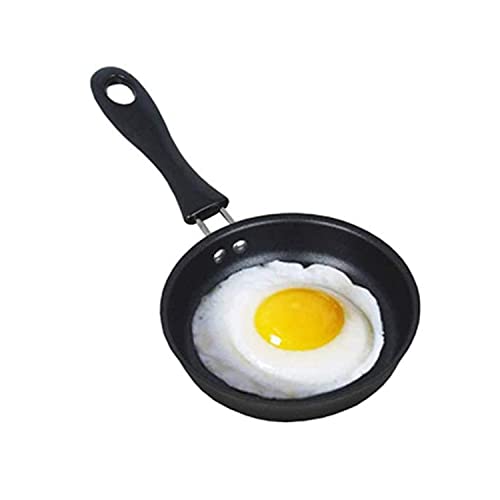
- Non-stick and anti-scratch coating allows food to easily slide off, durable and wear resistant, non-toxic, safe and healthy cooking. Superior nonstick interior and exterior make
- Made of thickened cast iron with non-stick coating inside and outside, healthy, safe and durable to use, offering even heating. You can use this egg pan for many years without the
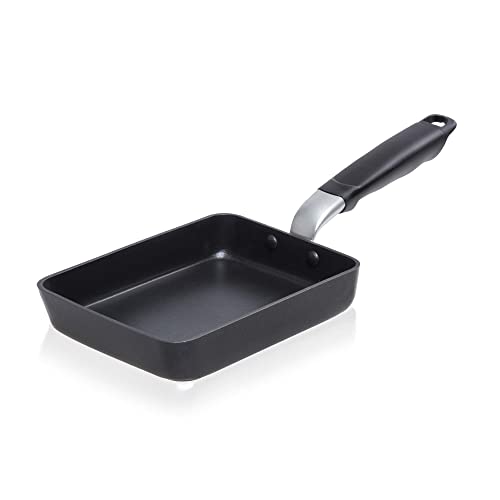
- Built for Performance: Forged heavy-gauge aluminum (commercial-grade 3004) construction distributes heat evenly and prevents hot spots
- Exceptional Design: The specially designed sloped front and straight sidewalls make it easy to flip and roll omelets
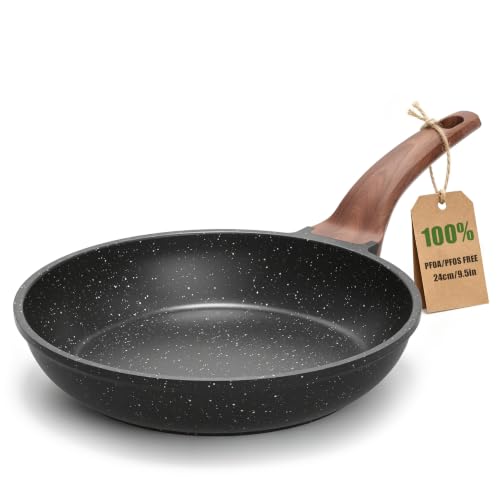
- 【Ultra Non-Stick & Toxic-Free】 Features a premium grey granite coating that is 100% PFOA Free, PFOS Free, PTFE Free, and Chemical-Free. Enjoy healthy, Toxic Free cooking with
- 【Even Heating & All Stovetops】 Crafted from lightweight, heavy-duty cast Aluminium for rapid heat transfer and even heating without warping. Highly versatile and compatible with
The Problem: Induction Doesn't Heat Pans, It Heats Metal in a Magnetic Field
A gas flame will heat anything you hold over it. Induction is different. The coil under the glass generates an alternating magnetic field, and the pan itself becomes the heating element. No ferrous metal sitting in that field means no heat — and, on most hobs, no ignition at all. The ring flashes an error or a pan-detect symbol and shuts off.
So you have two separate failure points:
- Material. The base has to be magnetically responsive.
- Size. Enough of that magnetic base has to sit inside the coil's field for the hob's sensor to register a pan.
Step-by-Step: Measuring Your Pan Base for Induction
Follow this in order. It takes about two minutes per pan.
- Turn the pan upside down on a flat surface. Work from the base, never the rim.
- Find the flat contact area. On many pans the outer edge curves upward before it meets the sidewall. Only the genuinely flat portion couples with the coil.
- Measure that flat disc edge to edge with a ruler or tape, across its widest point. Write the number down in both inches and centimetres — hob manuals frequently list minimums in centimetres.
- Do the magnet test. Stick a fridge magnet to the centre of the base. Weak pull or no pull means it will not work regardless of size. Strong snap means the material is fine.
- Check the magnet at the base edge too. Some pans have a small ferrous disc embedded in a wider aluminium base. The magnetic disc is your real working diameter, and it may be considerably smaller than the flat base you just measured.
- Compare against your hob manual's minimum for each ring. Every ring has its own figure. Your smallest ring will accept the smallest pan; your largest ring usually has the highest minimum.
Matching Pan Diameter to Ring Size
The practical rule: put small pans on small rings. If your pan base is meaningfully narrower than the ring's marked circle, move it to a smaller ring even if the big one technically detects it. An undersized pan on an oversized ring gives you uneven edge heating and, on some hobs, intermittent cut-outs as the sensor loses confidence in the load.
Going the other way is safer but not free. A pan base substantially wider than the ring will heat strongly in the middle and stay cooler at the perimeter, because the coil below simply does not reach that far out.
If you cook a lot of single-portion food — one egg, one sausage, a handful of nuts — you do not need to force a full-size skillet onto a small ring. Buy a pan built at that scale instead. That is where the products below come in.
Tools & Products You'll Need
Demoyaya One Egg Frying Pan — Best for the smallest ring on your hob
The listing states a diameter of 12 cm / 4.72 in and a depth of 3 cm / 1.1 in. It does not say where that diameter is measured, so treat it as an overall pan size rather than a flat base figure — the number you actually need to compare against your hob manual's minimum detection diameter is the flat magnetic base, which you can only get by measuring the pan yourself once it arrives.
The listing describes it as made of thickened cast iron with non-stick coating inside and outside, and says it works on electric furnace, gas stove, induction hob, grill and other stoves. Cast iron is the material induction likes best, so the material side of the equation is settled. The size side is on you: the flat base will be no wider than the stated 12 cm and the listing does not say how much narrower, so if your smallest ring's minimum is anywhere near 12 cm, measure the base before you rely on it.
Strengths: a published diameter and depth; cast iron construction; bakelite handle with a screw reinforcement and a half-inch hanging hole.
Limitations to weigh: the stated 12 cm / 4.72 in diameter is a one-egg footprint, so it is not a general-purpose pan. Note also that the listing gives the diameter but does not say where it is measured or how much of the base is flat contact area.
TECHEF - Tamagoyaki Japanese Omelette Pan/Egg Pan Skillet — Best for rectangular ring coverage
Rectangular pans are the awkward case in any diameter discussion, because a round coil has to detect a non-round base. TECHEF publishes the dimensions: Medium is a rectangle at 7.5 x 5.5 x 1.2 inches and Large is a square at 8.5 x 8.5 x 1.2 inches. Read those as a footprint, not a diameter — the narrow dimension is what has to clear your ring's minimum.
The listing describes an induction-ready heavy-duty forged base that it says ensures no warping or wobbling and works with electric, gas and ceramic stoves including induction. Flatness matters more than usual on induction, since any rocking lifts the base out of the field. The pan is forged heavy-gauge aluminum, commercial-grade 3004, which the listing credits with even heat distribution.
Strengths: published dimensions for both sizes; a forged base the manufacturer specifically frames as anti-warp; 3-layer reinforced Teflon nonstick stated as PFOA-free with no cadmium or lead; oven safe up to 350°F and dishwasher safe.
Limitations to weigh: the 350°F oven ceiling is low if you like finishing dishes under high heat. And PFOA-free is a specific claim about one compound — the listing describes a Teflon coating, so do not read it as PTFE-free.
YASHE 9.5 Inch Granite Nonstick Frying Pan — Best for a standard mid-size ring
The 9.5 inch figure here is the pan size as sold; the listing does not say where it is measured or give a flat base diameter, so treat it as an overall size rather than a base figure. Still, a 9.5 inch pan is the size most mid and large rings are designed around, so detection is rarely the issue at this scale.
The listing states cast aluminium construction for rapid heat transfer and even heating without warping, and lists compatibility with induction hob, gas, ceramic, electric and halogen. On coating, this is the outlier of the three: the listing claims 100% PFOA free, PFOS free and PTFE free granite coating — a broader claim than the TECHEF pan's PFOA-free Teflon.
Strengths: the stated PTFE-free granite coating; the manufacturer's no-warp claim, which matters for base-to-glass contact; a Bakelite woodgrain handle described as staying cool to the touch, plus a hanging hole.
Limitations to weigh: these coating claims come from the seller's listing, not independent verification. The listing also positions it for couple meals and single meals rather than large-batch cooking.
Tips for Best Results
- Centre the pan on the ring. Off-centre placement reduces coupling and can drop the hob out of detection mid-cook.
- Prefer the smallest ring that comfortably fits the base. It concentrates the field where the pan actually is.
- Check flatness by setting the pan on a countertop and pressing one edge. Any rock means poor contact.
- Keep the glass and the pan base clean. Grit under the base creates a gap and a scratch risk.
- If you're building a set, buy for the rings you own, not for a generic "starter set" spread of sizes.
Common Mistakes to Avoid
- Measuring the rim. The single most common error. Always measure the base.
- Assuming "induction compatible" means "works on every ring". Compatibility is about material; detection is about size.
- Ignoring the embedded-disc trick. A wide aluminium base can hide a narrow steel disc. The magnet finds it.
- Using a warped pan. Induction is unforgiving about base contact in a way gas never is.
- Buying by pan volume instead of base diameter. A deep small-base saucepan can fail detection on a large ring.
How We Research
This website does not perform product research. For this guide, every product fact was taken from the Amazon Creators API verified product record and the product listing feature bullets for each ASIN, retrieved 6 September 2026. We read the published dimensions and material statements closely and reason from them — treating a listed pan size, whether a "12 cm diameter" or a "9.5 inch" figure, as an overall dimension that does not by itself tell you the flat base measurement a hob's minimum is compared against. Where a listing does not state something, such as flat base contact area or where a diameter is measured, we say so rather than estimating.
For general consumer safety guidance and recall information, CPSC and USA.gov consumer protection are the appropriate authorities.
Final Verdict
Buy for your rings, and measure the base before you order. If you have a genuinely small ring and you cook single portions, the Demoyaya One Egg Frying Pan is the one built at that scale, with a listed 12 cm / 4.72 in diameter — though the listing does not say where that figure is measured, so check the flat base against your manual once the pan is in your hands. For everyday cooking on a mid-size ring, the YASHE 9.5 Inch Granite Nonstick Frying Pan is the sensible default, and its stated PFOA-, PFOS- and PTFE-free granite coating is the broadest coating claim in this set. Choose the TECHEF - Tamagoyaki Japanese Omelette Pan/Egg Pan Skillet only if you specifically want the rectangular rolled-omelette format and can live with the 350°F oven limit.
None of that replaces the two-minute check: flip the pan, measure the flat base, test with a magnet, compare to your hob manual.
Related Resources
- How induction cooktops work
- Best cookware materials for induction
- Nonstick coating types compared
Frequently Asked Questions
Do small pans work on induction hobs? Yes, provided the base is magnetic and meets the ring's minimum. Pans built at small scale exist for exactly this: the Demoyaya One Egg Frying Pan lists a diameter of 12 cm / 4.72 in and states it works on induction hobs, though the listing does not say whether that figure is the flat base measurement, so measure the base against your ring's minimum.
Should I measure the top or the bottom of the pan? The bottom, and specifically the flat portion that contacts the glass. Rim measurements overstate the working diameter every time.
Can a pan be too big for an induction ring? It can overhang without harming anything, but the area outside the coil's field heats only by conduction through the metal, so edges run cooler than the centre.
Does a rectangular pan work on a round induction ring? It can, if enough magnetic base sits over the coil. The TECHEF - Tamagoyaki Japanese Omelette Pan/Egg Pan Skillet lists a Medium rectangle at 7.5 x 5.5 x 1.2 inches and a Large square at 8.5 x 8.5 x 1.2 inches, and its listing states an induction-ready forged base.
Why does my hob keep cutting out with a small pan? Usually the base is near or below the ring's detection threshold, or the pan has drifted off-centre. Move it to a smaller ring and re-centre it.
Does "induction ready" guarantee my hob will detect it? No. That phrase addresses material compatibility. Detection also depends on the base diameter meeting your specific ring's minimum.
Sources & Methodology
No pan on this page was cooked with, weighed, or laboratory-assessed by this website — we run no kitchen and no lab. What we did instead was pull the Amazon Creators API verified product record and every product listing feature bullet for each of the three ASINs on 6 September 2026, then read the published dimensions against the one thing that actually decides induction compatibility: base diameter versus ring minimum. That method has a hard limit here: none of the three listings states a flat base diameter, so the published sizes narrow the field but cannot replace measuring the pan. It also stops short of telling you how a coating wears, since no supplied source addresses long-term durability.