As an Amazon Associate this site earns from qualifying purchases.
Quick Picks
| Product | Base construction | Best for |
|---|---|---|
| duxtop Stainless Steel Frying Pan | Heavy gauge impact-bonded aluminum encapsulated bottom [S5] | Everyday searing where a thicker base is the priority |
| Cuisinart 8-Inch Open Skillet | Aluminum encapsulated base [S3] | Small-burner eggs and single portions |
| Duxtop Stainless Steel Sauce Pan with Lid | Impact-bonded base [S4] | Sauces and boiling where a lid does the heat lifting |
Disclosure: We earn a small commission from qualifying Amazon purchases at no extra cost to you.
Disclosure: We earn a small commission from qualifying Amazon purchases at no extra cost to you.
As an Amazon Associate, we earn from qualifying purchases.Last Updated: September 2026
The short answer: pans warp on induction because the base heats faster than the rest of the pan can keep up with, and the fastest way to stop it is to preheat on medium with a dry empty pan for a short spell, never blast an empty pan on full power, and never move a screaming-hot pan into cold water. Induction does not create warping out of nothing. It just punishes the heat habits that gas quietly forgave.
Here's the thing about induction: the magnetic field couples directly with the pan's own base. That means the base is the heating element. On gas, a flame licks up the sides and spreads the load. On induction, the energy lands in a disc on the bottom, and any temperature difference between that disc and the cooler walls above it turns into mechanical stress. Do that repeatedly, or violently, and a flat base becomes a rocking base.
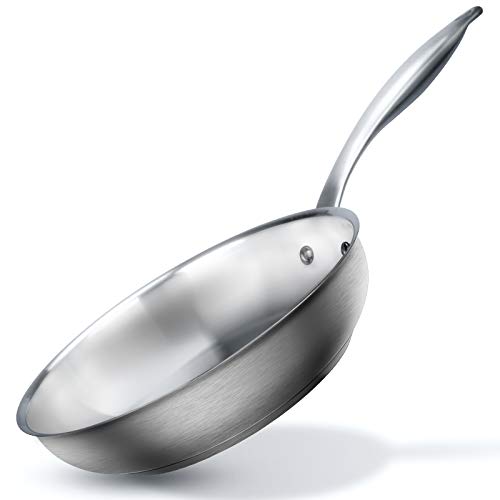
- HIGH QUALITY MATERIAL: This 9.5 inch fry pan is manufactured with 304 food grade stainless steel. Heavy gauge impact-bonded aluminum encapsulated bottom for quick and even heating
- FEATURES: The induction fry pan features a classic straight-sided and drip-free pouring design. Riveted to the pan is a stay-cool stainless-steel perfect-grip handle, allowing for
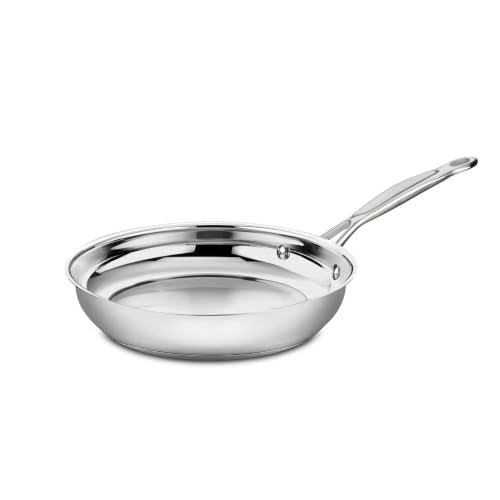
- CONFIDENCE IN EVERYDAY COOKING — The proven Cuisinart stainless cookware delivers dependable performance for everyday cooks. Built with a mirror-finish stainless steel body, this
- EVEN HEAT AND MIRROR FINISH — A pure aluminum encapsulated base heats quickly and spreads heat evenly across the bottom, helping eliminate hot spots. The mirror-finish stainless
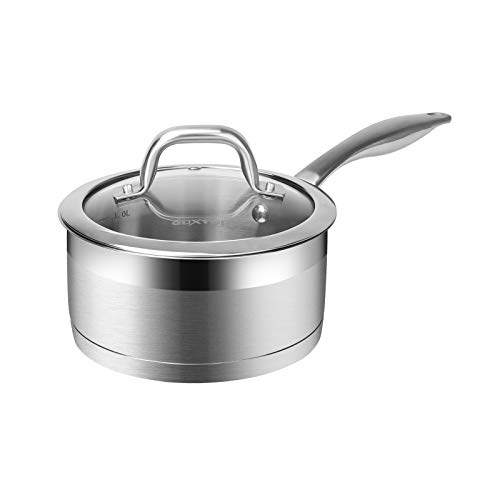
- HIGH QUALITY MATERIAL: This 1.6 quart saucepan is manufactured with food grade 304 stainless steel featuring an impact-bonded base allowing for fast and even heating
- FEATURES: The stainless steel pot features a classic straight-sided and drip-free pouring design. Riveted to the pan is a stay-cool stainless-steel perfect-grip handle, allowing
The Problem: Why Your Pan Wobbles on Induction
A warped pan on an induction cooktop is worse than a warped pan on gas, and the reason is contact. Induction needs the ferromagnetic base sitting flush against the glass. A base that has domed upward in the middle, or curled at the rim, loses coupling area. You get slower heating, uneven browning, oil pooling in a ring, and on some cooktops an intermittent buzz or a unit that cycles because it cannot read the load cleanly.
Three habits cause most of it.
- Empty pan, maximum power. Induction dumps energy into thin bases fast. An empty pan has nothing absorbing that energy, so base temperature runs away from wall temperature.
- Cold liquid into a ripping-hot dry pan. The base contracts, the sides do not, and the metal takes the difference.
- The sink. Carrying a hot pan straight to cold tap water is the single most abrupt thermal shock a home cook can hand a piece of cookware.
Step-by-Step: How to Stop Pans Warping on Induction
- Match the pan to the ring. Use a pan whose base roughly covers the marked cooking zone. An undersized base concentrates the field into a smaller area of metal.
- Preheat on medium, not high. For preheating stainless steel on induction, set roughly the middle of your power scale and give it a short dry warm-up rather than a fast blast. You are trying to bring the whole pan up together, not just the disc.
- Preheat empty for the shortest time that works. Dry preheating is standard practice for stainless searing, but the clock matters more than the setting. Short and moderate beats long and hot.
- Add fat before the pan reaches smoke point. Oil in the pan gives the base something to hand its heat to, and it tells you visually when you have gone too far.
- Add ingredients at room temperature where practical. Fridge-cold protein straight onto a dry, very hot base creates a sharp local temperature drop.
- Never deglaze with ice-cold liquid at full heat. Drop the power first, then add liquid. Warm or room-temperature stock is gentler than cold.
- Let the pan cool on the cooktop or a trivet. Air cooling takes minutes and costs nothing. Quenching in the sink costs you a flat base.
- Store pans without stacking heavy pots inside thin ones. Deformation is not always thermal.
Tools and Cookware That Help
Base construction is where you should be spending your attention. A thin single-ply disc has less material to absorb and spread an energy surge; a heavier bonded base has more. The listings below publish their base construction directly, which is exactly the spec worth reading before you buy flat base cookware for induction.
duxtop Stainless Steel Frying Pan, 9.5 Inch Induction Skillet — Best for everyday searing on induction
This is the one to look at first if base thickness is your concern. Duxtop describes the 9.5 inch fry pan as 304 food grade stainless steel with a heavy gauge impact-bonded aluminum encapsulated bottom for quick and even heating [S5]. That phrase does real work: "heavy gauge" and "impact-bonded" together suggest a base with more aluminum mass sandwiched into it, and more mass is more thermal buffer between your power setting and the steel skin. The listing also calls out a heavy bottom on the skillet and stainless rivets fixing the stay-cool handle [S5].
Duxtop rates the cookware oven-safe to 500°F and says it is dishwasher-safe and freezer-safe for food storage [S5]. Read that freezer note carefully — safe for storage is not an invitation to move the pan between the freezer and a hot hob.
Suits: cooks who want a mid-size stainless skillet and treat base construction as the deciding spec. Limitation to know: the supplied listing information does not state the base thickness in millimetres or the pan's weight, so "heavy gauge" is the manufacturer's own characterisation rather than a published measurement.
Cuisinart 8-Inch Open Skillet — Best for small-zone cooking and eggs
At 8 inches this is a small-burner pan, and that matters for warping: a smaller base is easier to keep fully inside a cooking zone, which avoids the field concentrating on part of the disc. Cuisinart states the skillet has an aluminum encapsulated base that heats quickly and spreads heat evenly, eliminating hot spots [S3]. Even heat spread is the whole ballgame here — hot spots are localised expansion, and localised expansion is how bases dome.
The listing also notes solid stainless steel riveted cool grip handles that stay cool on the stove top, a stainless cooking surface that does not discolor or react with food, dishwasher-safe cleanup, and a lifetime warranty with the user manual as the reference for warranty policy [S3].
Suits: anyone cooking one or two portions who currently overheats a large pan on a small ring. Limitation to know: Cuisinart's listing does not state an oven temperature rating for this skillet, so do not assume it matches the Duxtop figures.
Duxtop Stainless Steel Sauce Pan with Lid, 1.6 Quart Induction Cooking Pot — Best for lidded liquid cooking
Saucepans warp less often than skillets for one obvious reason: they usually have liquid in them. Duxtop's 1.6 quart saucepan is made from food grade 304 stainless steel with an impact-bonded base for fast and even heating, and ships with a tempered glass lid that has a built-in steam vent and loop handle to retain heat and moisture [S4]. A lid keeps you working at lower power for the same result, and lower power is the cheapest anti-warp measure there is.
Duxtop rates the cookware oven-safe to 550°F with the glass lid oven-safe to 400°F, and lists it dishwasher-safe and freezer-safe [S4]. It is described as suitable for induction, gas, electric and halogen cooktops [S4].
Suits: milk, sauces, small-batch boiling, and cooks who want an induction-compatible pot they can also finish in the oven.
Tips for Best Results
- Test flatness with a straightedge or a ruler laid across the base in two directions. Light under the middle means doming.
- If a pan spins freely on the glass, it is already warped. Spinning is not a quirk; it is a diagnosis.
- Use the lid. It cuts the power you need, which cuts the thermal gradient.
- Boost and power-boost functions are for bringing liquid to a boil, not for preheating dry metal.
- Keep the cooktop glass and the pan base clean. Debris between them creates uneven contact and localised hot spots.
Common Mistakes to Avoid
- Preheating dry on high "to save time." This is the number one cause of warping on induction.
- Assuming a warped pan will flatten out. It will not, and hammering it flat risks damaging bonded base layers.
- Buying by weight alone. Published construction language — encapsulated, impact-bonded, heavy gauge — tells you more than heft in a store aisle you cannot feel from an online listing anyway.
- Treating freezer-safe as thermal-shock-proof. Duxtop lists both products as freezer-safe for food storage [S4][S5]; that is a storage claim, not a temperature-cycling claim.
How We Research
This website does not perform product research. For this guide we worked from the Amazon Creators API verified product records for each ASIN and the product listing feature bullets published on those listings, all retrieved 2026-09-06, and we reasoned from the base-construction language each manufacturer publishes. Where a listing does not state a figure, we say so rather than estimating one.
Frequently Asked Questions
Final Verdict
If you want one purchase that addresses warping directly, the duxtop Stainless Steel Frying Pan is the pick, because it is the only one of these three whose listing specifically describes a heavy gauge impact-bonded aluminum encapsulated bottom [S5] — more base mass is the structural answer to the thermal-gradient problem. Choose the Cuisinart 8-Inch Open Skillet instead if your problem is a big pan on a small zone, and the Duxtop Stainless Steel Sauce Pan with Lid if most of your induction cooking involves liquid and a lid.
But be honest about the real fix. No base construction survives a habit of blasting empty pans on boost and quenching them in the sink. Change the habits first; the cookware is the insurance policy.
Related Resources
- Best induction-ready stainless steel cookware
- How to preheat stainless steel without sticking
- Induction cooktop buying guide
- For general consumer product safety information and recall notices, see the U.S. Consumer Product Safety Commission at cpsc.gov [S1] and consumer protection guidance at USA.gov [S2].
Sources and Methodology
Nobody at this website put a straightedge on these pans, ran them on a cooktop, or measured a base. What we did do was read each product's Amazon Creators API verified product record and its published listing feature bullets, retrieved 2026-09-06, and compare the base-construction language line by line — encapsulated versus impact-bonded versus heavy gauge impact-bonded — alongside the oven ratings each manufacturer chose to publish. For cookware warping specifically, that kind of reading gets you a long way, because base construction and oven ratings are exactly the specs manufacturers do publish and exactly the ones that govern how a pan handles a steep thermal gradient. What it cannot tell you is how any individual pan behaves after two years of daily use, and no listing bullet promises that.